Written By: Fabrizio Beverina
The first time I set foot on that sacred mountain, scattered with ancient temples, the world below began to melt away. The noise of the city, the weight of its endless chatter, fell away with each bend in the winding path. At the summit stood a small hut, home to a Zen hermit who lived with almost nothing: a kettle for tea, a mat for meditation, and the quiet repetition of a mantra as he walked with his wooden stick.
I stayed with him for a month and a half. Tired of lectures and the endless explanations of academic life, I found myself listening to a different language: one I could finally understand. He never spoke in concepts or theories; instead, he revealed the spiritual world through gestures and small “miracles,” each one bypassing my intellect and sinking straight into the marrow of my being.
Months later, I traveled far to the west and settled in a Tibetan Buddhist temple high in the mountains of Nepal. The air was saturated with the fragrance of incense, while the deep vibration of chanting rolled through the halls like distant thunder. Between prayers, young monks darted through the courtyards, their laughter ringing like small bells above the steady heartbeat of the temple drum. I remained there for three months, sharing in their daily rhythm: playing with the smiling novices, eating alongside them, and quietly weaving myself into the fabric of their lives.
Many Paths, One Teaching
Over time, I began to see that beneath the surface differences of their rituals, these traditions pointed toward the same essential truth, a truth I would later find echoed in unexpected places.
In the writings of Aleister Crowley, for example, I was startled to read the same idea expressed in the language of magic: the first step in making magic is to know yourself. Whether in Buddhism, shamanism, or esoteric magic, the message is the same: strip away what you are not. Only when you clear yourself of false layers and uncover your true nature can the nature outside you flow through you. And when it does, you stand with all the power of the living world at your back: the same power that creates life itself and this astonishing universe in which we live.
From these traditions, I carried a teaching that would only truly come alive years later in the Amazon: the mind is like a mirror. Over time, it gathers dust: our fears, habits, and old pain, until we mistake the dust for the mirror itself and can no longer see clearly. The work is not to add anything new, but to wipe away what obscures what has always been there, to see reality as it is, and to reconnect with its deepest truth.
My first ayahuasca ceremony took me back to the ten days of silent Vipassana meditation I had once endured in India. In Vipassana, the mind is cleansed of false ideas through the relentless discipline of observing pain and impermanence. With ayahuasca, the cleansing speaks another language: purging, vomiting, shaking, even screaming. In both places, I saw people pushed to their edge, longing to escape, just as I had witnessed in Vipassana years before, and later again in the Amazon. The two paths shared the same core truth: purification through fire. Pain becomes the flame that burns away what is no longer needed, leaving only what is real.
Years earlier, in a guided Tibetan meditation, we were told to imagine snakes, bugs, and spiders emerging from our mouths, ears, and various holes: a symbolic expulsion of everything hidden in the subconscious. It was a way to purge the mind’s poisons, to give form to what needed to be released.
Ayahuasca works in much the same way. Many people I’ve sat with have described visions of vomiting snakes or insects, and when they tell their stories, I recognize them instantly. This is the language of the medicine: the symbolic speech that reaches directly into the subconscious, far beyond the grasp of words.

Purging: Cleaning the Mirror, Making Space
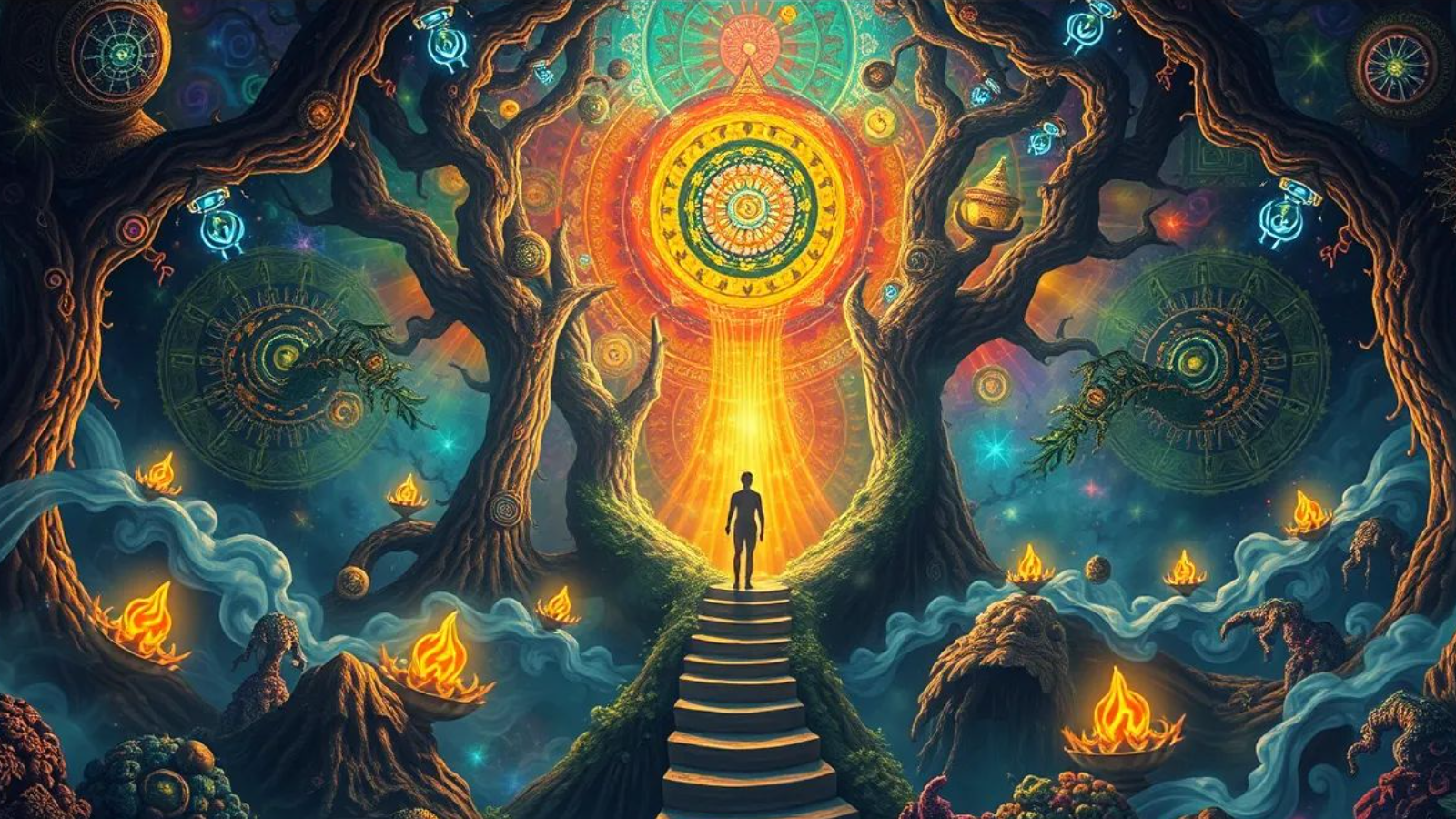
To clean the mirror is to make space. Space for light, space for clarity, space for something new to enter. When we purge whether through vomit, tremors, tears, sweat, shaking, yawning, or visions, we are not just expelling physical matter. We are releasing stale emotions, outdated beliefs, and the residue of old stories that have been quietly taking up room inside us.
In the physical realm, purging is unmistakable: the tightening of the stomach, the rising bitterness in the throat, the sudden, cathartic release. Our memories are not stored only in the brain; they live in the body, woven into our muscles, our breath, and especially our gut. In the symbolic realm, purging is like pulling weeds from a garden. And as in any garden, new life cannot take root if the soil remains choked with what no longer serves.
I’ve seen people vomit for minutes, only to later describe it as “the sweetest relief,” as if something ancient and heavy had finally left their bodies. Others tremble uncontrollably, shaking loose the tension of years. Some cry as if emptying an old reservoir of grief they didn’t know they were carrying. And some purge only in visions: coughing up snakes, retching insects, or watching dark smoke rise from their chest and vanish into the night.
These are not just hallucinations. They are the mind’s symbolic language in action: the subconscious translating inner transformation into images the soul can recognize. When we vomit a snake, we are not ridding ourselves of a literal reptile; we are releasing something toxic that has coiled inside us, something that once had a grip on our life force.
The purge is both the act and the signal: something is leaving, and space is being created. Without that space, nothing new can truly take root. After a strong purge, people often describe a surprising sense of lightness, as if a window has been thrown open inside them and fresh air is pouring in.
This is why, in the cosmology of many Amazonian traditions, the purge is not seen as an unpleasant side effect but it is the medicine’s most sacred work. It is the moment when the mirror is wiped clean. And a clean mirror doesn’t just reflect more light, it allows us to recognize ourselves again.
The Analog Language of Change
The psychologist Paul Watzlawick, in his book The Language of Change, argued that the most effective way to create transformation is to speak the analog language of the subconscious: the language of images, sensations, metaphors, poetry, and music, rather than the digital language of logic and words. The logical brain is a strict gatekeeper, censoring and filtering anything that might threaten its established worldview: a form of self-protection designed to preserve the ego’s fragile sense of control.
Watzlawick noted that there is no fixed method for speaking to the subconscious. His book does not offer a step-by-step technique, only an observation that when change happens, it often comes through this indirect, symbolic channel. And yet, this is exactly what ayahuasca does, effortlessly and continuously. She is nature, and this is the language of nature itself.
Ayahuasca bypasses the gate entirely. By speaking in dreams, visions, archetypes, and purges, she slips past the watchful guard of the conscious mind and works directly where change is possible. And she works in full sensory immersion: sight, sound, smell, taste, touch, proprioception, and waves of emotion. This makes the experience as real and impactful as anything we live in ordinary waking life, often more real. This is her strength: a depth of impact that the words of a psychotherapist, however skilled, can rarely match. The experience etches itself directly into the subconscious, leaving a mark that bypasses the verbal mind entirely.
It is in this natural, symbolic language that ayahuasca achieves her most astonishing results — results that are not forced, but allowed, as if the living intelligence of the forest itself is working through us.
What the Data Shows
At Paojilhuasca, we’ve even seen this reflected in our data. Using the Nondual Embodiment Thematic Inventory (NETI) questionnaire to track transformation, we noticed a clear trend: the more a person approaches life through intellect and rational analysis, the lower their measurable results after working with the medicine. The ones who can surrender into the analog language of the subconscious, without needing to decode it immediately, tend to experience the deepest, most lasting change.
Some people leave a retreat saying they “got nothing”: no message, no clear visions, no recovered memory of trauma. Yet when we measure their progress, we often see significant increases in well-being and inner peace. We don’t always need to know how the work was done, because in any case, the work was done. New neural connections have formed, new neurons have been created; the hardware has been modified even if the conscious mind is unaware of it. In time, behavior reveals the change.
Beyond the Tip of the Iceberg
Ayahuasca doesn’t address the conscious mind that small, logical, verbal tip of the iceberg. She speaks in a kind of machine language of the psyche, bypassing the chatter and diving into the vast, hidden body of the iceberg beneath the surface.
This is where the real transformation happens: in the deep waters where patterns are formed, where trauma hides, and where identity takes shape. The conscious mind often tries to interfere, asking, “What does this mean?” But the moment we try to conceptualize it too soon, we pull the work back to the surface, stripping it of its depth.
Ayahuasca is not a lecture; she is a reprogramming. The visions—snakes, insects, floods, jaguars—are not random hallucinations. They are the subconscious speaking in its native tongue. In that space, purging is not just a physical act but a symbolic one, an exorcism of the imagery that binds us.
Integration means letting these symbols work on us long after the ceremony, allowing the seeds planted in the dark soil of the subconscious to grow at their own pace, without uprooting them for immediate analysis.
The work, as I’ve learned it, is not to force understanding but to surrender to it, to let the medicine work where thought cannot reach. We purge, we clean the mirror, we make space, and then we wait. Somewhere in the stillness, beyond the reach of thought, something ancient begins to stir.
Ayahuasca does not hand us the truth wrapped in words; she removes the veils that hide it. She clears the path so that life itself—vast, intelligent, and endlessly creative—can move through us unhindered. The rest unfolds in its own time, like a forest growing in silence.
Nothing is given, nothing is taken. What remains is the quiet presence of what has always been: our own nature, woven into the great fabric of life, luminous, unbound, and endlessly alive.